STRATEGY AND SCENARIO ANALYSIS
Goals of creating a more stable and efficient financial system and achieving global objectives for reducing greenhouse gas emissions are reflected in the Group’s business strategy. In particular, the following ESG projects were implemented as part of Strategy-2024:
- expansion of exchange products and services to address environmental and social issues;
- informing issuers and other market participants about trends in the development of reporting, significant ESG issues and risks;
- ensuring the continuity of the Group’s companies’ operations and their resilience to risks.
The first two projects were also aimed at expanding the capabilities of financial market participants and issuers in managing climate risks and raising awareness about them, while the third project focused on improving the Group’s internal processes, including the integration of climate risks into the risk management system.
The new Strategy-2028, adopted in September 2023, includes six priorities - three business directions and three achievement catalysts. The task of expanding ESG product offerings has been incorporated into the business direction “Development of Capital Markets,” while the transformation of corporate culture and processes is one of the achievement catalysts.
In 2023, Moscow Exchange analysed the Group’s exposure to climate risks, including those related to products and services provided. Moscow Exchange assessed its interactions with customers, partners, and suppliers in this context. To analyse possible options, quantitative and qualitative methods of risk assessment were employed, including scenario analysis. Moscow Exchange also identified new opportunities for the Group companies and financial market participants associated with the transition to a lower-carbon global economy.
As part of scenario analysis, the impact on the financial performance of Moscow Exchange Group of implementing different NGFS (Network for Greening the Financial System) scenarios related to an orderly transition has been assessed.
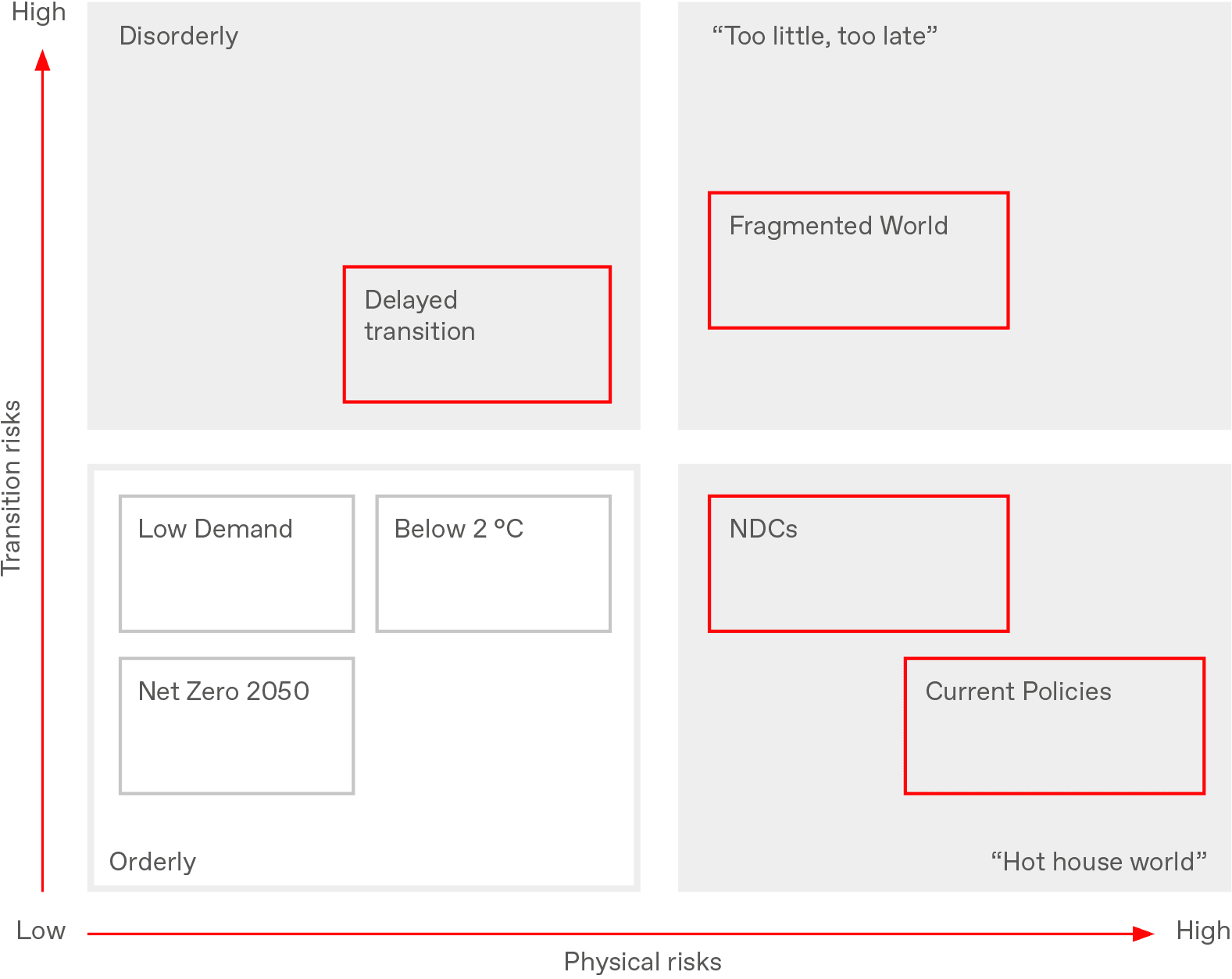
The following scenarios from the NGFS climate scenario matrix were selected for the analysis:
1.4°CAccording to the scenario, the increase in global temperature should be limited to this value. | “Net Zero 2050” Limits global warming to 1.5°C through strict climate policy and innovation, achieving net-zero CO2 emissions by 2050. Assumes immediate implementation of ambitious climate policy. |
1.4°C | “Low Demand” Significant behavioral changes reduce energy demand, easing pressure on the economic system. |
1.6°C | “Below 2°C” Climate policy is introduced immediately and gradually becomes more stringent. Net-zero CO2 emissions will be achieved after 2070. Physical and transition risks are relatively low. |
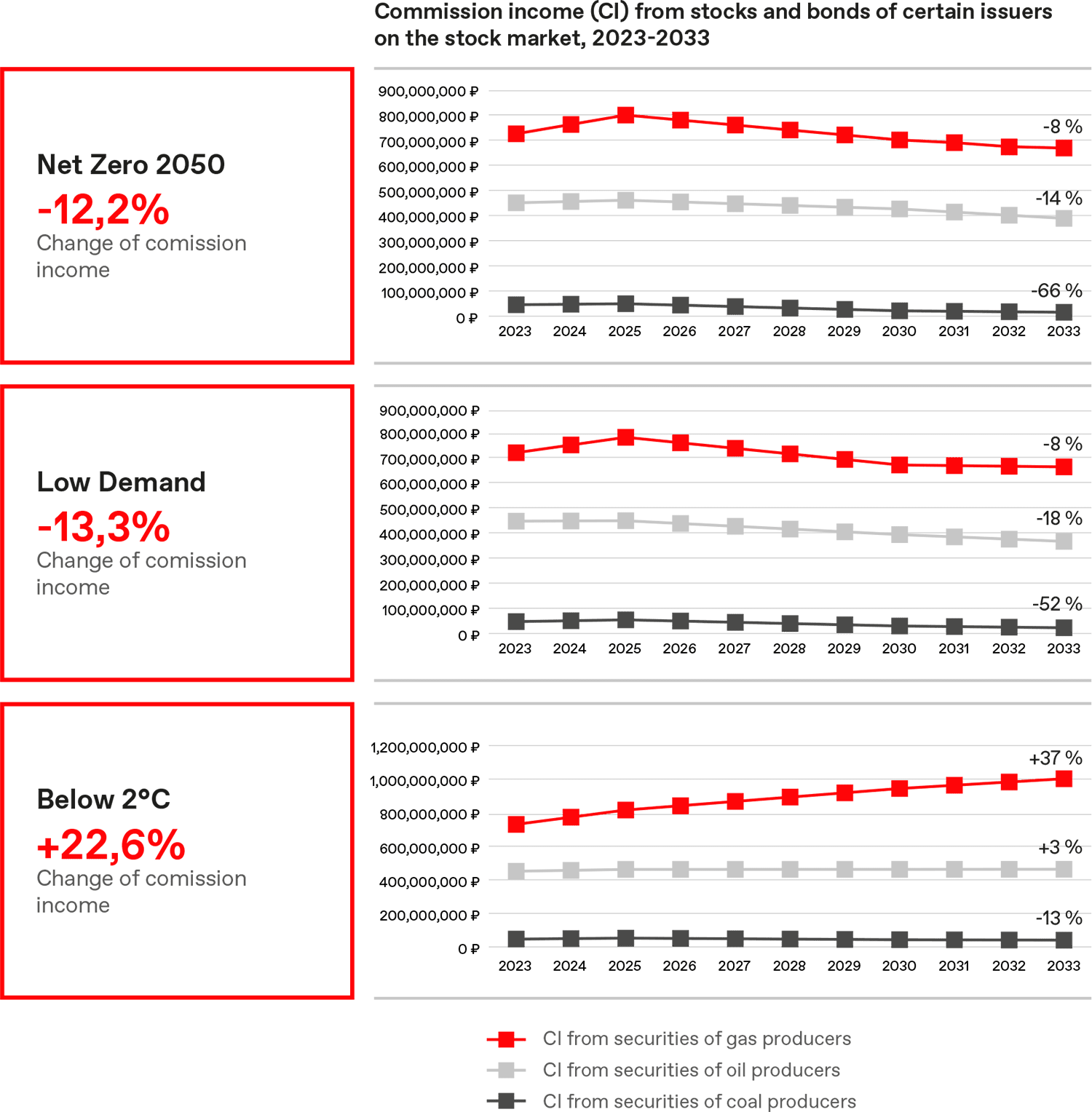
The analysis examined potential changes in revenues of issuers whose primary activity is the extraction/transportation/refining of energy resources (oil, gas, and coal) over the period from 2023 to 2033 as a result of the energy transition. During the scenario analysis, the impact of climate agenda factors on Moscow Exchange Group’s commission income from stocks and bonds of issuers involved in energy resource extraction/transportation/refining was evaluated.
The initial data included information on oil, gas, and coal sales volumes in the Russian Federation according to the GCAM (Global Change Assessment Model) modelGlobal model of the Joint Global Change Research Institute (USA), incorporating socioeconomic data, climate policies of agreements, and the development of technologies and resources. Refined since 1980..
Moscow Exchange Group’s strategic action plan for climate risk management includes the following key areas:
- enhancing the understanding of climate risks;
- regularly assessing climate risks (including physical and transition risks) and formulating actions to manage these risks in the short (less than a year), medium (1-5 years), and long term (5 or more years);
- integrating climate risks into Moscow Exchange’s general risk management processes;
- implementation and development of climate risk monitoring metrics;
- development of scenario analysis in climate risk management;
- disclosing information about:
- climate risk identification and assessment processes;
- appropriateness of scenarios related to climate change;
- key climate risks and, where applicable, their impact on financial performance; and
- measures taken to adapt to climate change;
- collaborating with regulators, industry associations, and international financial institutions to share best practices for managing climate risks.