Advanced practices of responsible investing
Exchanges contribute significantly to raising capital for improving sustainability. They also play an important role in in creating financing facilities to help modernize the economy in line with climate goals.
As a member of the Sustainable Stock Exchanges (SSE) initiative, Moscow Exchange works hard to develop sought-after financial ESG instruments and promote them among Russian companies, investors, and financial institutions. Moscow Exchange is striving to create a new market segment for environmentally and socially significant projects that are appealing for issuers and investors.
Moscow Exchange promotes responsible investment both as a company and as a provider of financial infrastructure, recognizing that the generation of long-term sustainable returns is dependent on well-governed social, environmental, and economic systems.
Moscow Exchange Group also promotes modern corporate reporting requirements, thereby contributing significantly to more transparent markets. The Exchange has developed infrastructure to foster a local investor base, and it provides access to funding for innovative companies, as well as small and medium-sized enterprises.
FN-EX-410a.3
Moscow Exchange requires issuers to disclose the following information that may affect stock prices:
- changes related to the company’s financial health;
- major corporate transactions, including restructurings, mergers, and acquisitions;
- changes to the management team;
- positive or negative material information on issuers’ products and services;
- legal or regulatory changes affecting the issuers’s ability to conduct business.
The grounds for suspending trading in securities are set out in the Listing Rules of Moscow Exchange. The decision to suspend trading in securities is made by Moscow Exchange on the basis of an expert opinion issued by the Listing Department. The Exchange contributes significantly to increased transparency of disclosures through its requirements for issuers.
3-3
As part of the work of the Sustainable Development Sector Council, Bond Issuers Committee and user committees, the Exchange performs regular analyses of feedback from customers and market participants about new ESG products; it also works to increase their awareness on such topics.
This subsection presents the main tools of responsible investment of Moscow Exchange PJSC and its educational projects for market participants.
Moscow Exchange Group’s objectives and the UN Sustainable Development Goals
- SDG 8.3, 9.3 Increase growth opportunities and access to financial markets for small and medium-sized enterprises
- SDG 8.10 Develop financial infrastructure for better access to capital markets, promote the development of a local investor base
- SDG 9.1 Increase access to financial services for retail investors
- SDG 9.b Increase growth opportunities and access to financial markets for companies that develop innovative products
- SDG 12.6, 12.8 Improve the quality and quantity of ESG information disclosed by issuers
- SDG 12.6, 13.3 Develop instruments to promote responsible investment
For comprehensive performance metrics for 2021, 2022 and 2023, see the subsection “Advanced practices of responsible investing” of the section “Sustainability Data” For the key policies, procedures, and responsible departments, see the subsection “Advanced practices of responsible investing” of the section “Sustainability Approaches and Procedures”.
Sustainability sector
203-2
In 2019, Moscow Exchange Group established the Sustainability sector to help issuers raise funds for environmental and socially significant projects. The Sustainability sector consists of four segments: green bonds, social bonds, sustainability bonds (as of 2021), and a segment for national and adaptation projects. For more details on the Sustainability sector and its core listing rules, see the section “Sustainability Approaches and Procedures”.
Currently the Sustainability Sector is composed of the following segments:
- Sustainability bonds (green, social, sustainability)
- Sustainability linked bonds
- National and adaptation projects
In December 2024, JSC Holding Company ‘Metalloinvest’ issued the first climate transition bonds on the Russian market within the Sustainable Development Sector, amounting to 10 billion rubles.
The creation of such sector is in line with the global best practices and represents one of the most important steps for Moscow Exchange as part of the UN initiative of Sustainable Stock Exchanges (SSE). About 134 exchanges take part in the initiative with only 53 of them currently having such a listing category.
As more and more investors prefer sustainable projects targeting the improvement of ecology and social environment, the Russian business is increasingly thinking about corporate social responsibility and application of the ESG principles in their operations. The sustainability sector will provide for proper positioning of issuers and investors with the targeted nature of investments.
Since the establishment of the Sustainable Development Sector, the total amount of funds raised by bond issuers has reached 493.5 billion rubles, with most of this amount accounted for by the issuance of green bonds.
RUB 417.6 billion in total bonds outstanding in the Sustainability sector by the end of 2024
RUB 52.8 billion of bonds placed in the Sustainability sector in 2024
In 2024 36 issues of ESG bonds were in circulation in the Sustainability sector, including 36 issues of green bonds, two issues of social bonds, 9 issues of national bonds and adaptation bonds.
Sustainability sector structure
In October 2024, bond labeling was introduced for instruments included in the Sustainable Development Sector. The short name of the instrument is appended with an additional letter ‘S’ (sustainability), signifying that the issuer adheres to sustainable development principles.
This labeling introduces a standard for identifying instruments within the sector, contributing to the development and unification of the sustainable finance market in Russia. It enhances market transparency and stimulates investments in sustainable development projects.
Corresponding changes have been made to the trading system to ensure the labeling is reflected in broker applications, simplifying the process for investors and market participants to locate green, social, and sustainable bonds.
Starting from February 7, 2024, the exchange began calculating and publishing a new bond index for the Sustainable Development Sector, reflecting the dynamics of bonds included in the sector.
The index calculation includes Russian corporate, sub-federal, and municipal bond issues within one of the three segments of the Sustainable Development Sector. Key selection criteria include a minimum issue size of 500 million rubles, a fixed coupon, and a duration of at least three months. The index is calculated once daily using total return and net price methods.
Building a market for trading in carbon units
The carbon unit register operated by Kontur JSC has been functioning in Russia since September 2022.
The carbon unit is a verified implementation result of the climatic project expressed as a mass of greenhouse gas equivalent to 1 tonne of carbon dioxide.
April 2, 2025, marked the first exchange auction for the sale of carbon units with additional supply control.
These carbon units were issued as part of the implementation of a climate project by specialized subsidiaries of PAO “Gazprom,” which are engaged in projects aimed at preventing methane emissions. This is achieved through the use of mobile compressor stations during the preparation of sections of main pipelines for maintenance work. The price of the carbon units in this transaction was 900 rubles per unit, including VAT.
The additional supply control involves collaboration between the trade organizer and the registry operator to facilitate the transfer of carbon units from the seller’s account to the buyer’s account within the registry. This mechanism is designed to expedite and automate the process of transferring carbon units after exchange transactions, enhancing efficiency and streamlining operations in the carbon market.
An interest is currently being observed in registering carbon units by Russian companies implement. Companies, which strategies include achieving carbon neutrality, are also interested in the carbon market as a means of reducing their carbon footprint.
Growth sector
203-2
In 2024 MOEX Group extended access to funds for small and medium-sized enterprises (SMEs) in the Growth sector, thereby facilitating their growth.
The Growth sector of Moscow Exchange was created for public offerings and for circulating the securities of promising small and medium-sized enterprises (for a detailed description of the sector and its listing rules, see the section “Sustainability Approaches and Procedures”).
The minimum credit rating level required is “ВВ–” according to the Russian scale from the following rating agencies: JSC AKRA, JSC Expert RA, and LLC NKR. Additionally, a “ВВ” rating from LLC NRA is required.
In circulation in the Growth Sector:
- 128 securities:
- 124 bonds
- 4 shares
- 68 SME issuers
- RUB 12 billion were raised by SMEs in the form of bonds in 2024
In 2024 41 SME issuers placed 52 bond issues and raised 12 billion RUB of debt financing (compared to 11.3 billion RUB of SME bond placements in 2023).
3-3
As a support measure, Moscow Exchange Group has improved accessibility to the bond market for SMEs by waiving charges for listing bonds for flotations of up to RUB 400 million. The grace period was extended up to 31 December 2025.
In order for issuers of SMEs from high-tech industries to receive a tax benefit in addition to support within the framework of the National Project “SMEs and Support for Individual Entrepreneurial Initiatives,”, the Moscow Exchange abolished the restriction on the simultaneous inclusion of securities in Growth Sector and IIM Sector.
Innovation and Investment Market
The key goal of the Exchange’s Innovation and Investment Market (IIM) is to promote investment to the companies at the innovation sector of the Russian economy.
As of the end of 2024, 37 securities were traded in the Sector for Innovation and Investment (Sector
In 2024, seven bond issues from five issuers totaling 25.8 billion rubles were placed in the RII Sector, and shares of four issuers were
To encourage high-tech companies to list on the stock exchange, the following types of government support are available:
- tax relief on income from the sale or other disposal of shares and bonds of Russian entities, and of investment units that are securities from the high-tech (innovative) sector of the economy, provided that they have been continuously owned by the taxpayer for at least one year prior to the date of their sale;
- tax incentive applies to share transactions in high-tech companies with maximum market capitalisation of RUB 75 billion, bonds of issuers with maximum annual revenues of RUB 75 billion, investment units (maximum net asset value (NAV) of RUB 75 billion);
- tax benefit for investors applies to income from the sale of securities up to 50 million rubles. Income exceeding 50 million rubles will be included in the taxable base for tax purposes.
ESG indices
203-2 FN-EX-410a.4
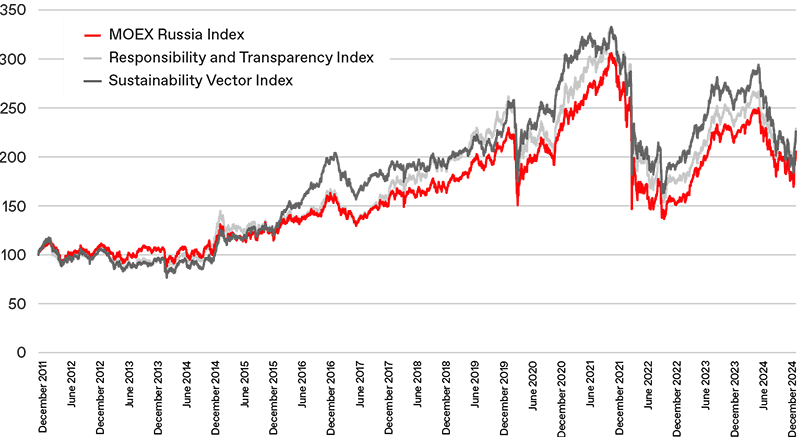
Moscow Exchange Group calculates and tracks Russia’s first sustainability indices. This is a joint project with the Russian Union of Industrialists and Entrepreneurs (RSPP). The MOEX-RSPP ESG indices help reveal a correlation between the quality of disclosures on responsible business practices and the yield dynamics of issuers’ stocks.
3-3
Each year, RSPP evaluates reports and ESG indicators of major companies operating in Russia. Moscow Exchange stock indices are based on this evaluation, as well as their derivatives, which create the basis for ESG ETFs . Since January 2021 Moscow Exchange has been listed on the RSPP Responsibility and Transparency Index and the Sustainability Vector Index.
On February 27, 2023, the Moscow Exchange began calculating and publishing index of shares in the field of sustainable development “Moscow Exchange Index - RAEX ESG Balanced” (MESG).
Moscow Exchange’s sustainability indices
- MOEX-RSPP Responsibility and Transparency Index, MRRT (calculation is based on the stock prices of 26 issuers, by the end of 2024);
- MOEX-RSPP Sustainability Vector Index, MRSV (calculation is based on the stock prices of 22 issuers, by the end of 2024));
- MOEX-RSPP Sustainability Vector Groos Return Index (calculation base includes companies with the best sustainability indicator dynamics, taking into account reinvestment of dividends);
- Moscow Exchange Index - RSP “Vector of Sustainable Development of Russian Issuers” (MRSVR) (as of the end of 2024, the calculation base included the shares of 22 issuers);
- MOEX-RSPP Russian Companies Sustainability Vector Total Return Index (based on the stock prices of issuers of Russian companies that have shown the best performance metrics in the field of sustainable development, accounting for the reinvestment of dividends);
- MOEX RSPP — RSHB Russian Corporate Eurobonds ESG Index (based on the Eurobond loans of Russian corporate issuers listed on the MOEX-RSPP Sustainability Vector Index). As of the end of 2024, the calculation base included 10 issues of bonds;
- Moscow Exchange
Index – RAEX ESG balanced. The calculation base for the new index includes 15 companies that are leaders in the RAEX ESG ranking; - The Derivative Index of the Moscow
Exchange – RAEX ESG Balanced Total Return (comprising shares of 15 companies leading the RAEX ESG ranking, including reinvested dividends).
A new version of the Sustainability Vector Index, the MOEX-RSPP Russian Companies Sustainability Vector Index. The methodology factors in regulatory requirements for non-state pension funds, making it possible to invest pension savings in a basket of index-linked securities or a financial product whose underlying asset is the new indicator.
FN-EX-410a.4
ESG ETFs
As of the end of 2024, the number of ETFs on the ESG indices of the Moscow Exchange amounted to five funds:
- ESGR ETF RSHB-MOEX-RSPP VecTR (ESGR);
- ESGR ETF RSHB-MOEX-RSPP Russian ESG Eurobonds (PRIE);
- SBRI ETF Responsible Invest (SBRI);
- WIMF ETF Russian Equity ESG (ESGEG);
- ETF “Technologies of the Future” by “Sistema Capital” Management Company (SCFT)
ESG guidelines
203-2 FN-EX-410a.4
Education and information of financial and commodity markets participants on the ways to integrate the ESG principles into the companies’ operations is an important mission for stock exchanges all over the world. Moscow Exchange meets that role by organising a conference sessions and webinars, as well as by supporting similar events of its partners.
The first Guidelines for Best Sustainability Practices (ESG Guidelines) published in 2021 by Moscow Exchange was positively received by issuers seeking to follow the sustainability principles. That is why a decision was made in 2024 to update for the third time the ESG Guidelines in order to reflect modern ESG trends.
The ESG Guide has been updated and expanded to incorporate modern trends and recent changes in the field of sustainable development. It includes revised recommendations for compliance with ESG requirements and attracting investors who choose to invest based on non-financial aspects of a business.
The new version of the guide includes sections on responsible investment and its principles, green energy consumption, and materiality assessment. It provides a more comprehensive coverage of the social aspect of ESG. The guide also details effective ESG communications, uses examples to illustrate responsible supply chains, and for the first time, reveals the main provisions and classification of the Taxonomy of Green, Adaptive, and Social Projects, which takes into account the specifics of the Russian economy.
Special attention in the guide is given to step-by-step instructions for improving business sustainability metrics, as well as methods for assessing and reporting on ESG factors. The guide complements the Central Bank of Russia’s recommendations in the field of sustainable development with practical examples and includes descriptions of the best ESG approaches of Russian companies.
Moscow Exchange believes that the ESG Guidelines may be used as a benchmark in the course of developing or improving corporate sustainability strategies, which will contribute to improving the quality of company management.
The fact that some 200 participants joined the presentation of the ESG Guidelines in January 2025 proves its importance for the Russian market.
Access to transactions with national bonds
In December 2021, the Finuslugi platform introduced the first service for the purchase and sale of national bonds of the constituent entities of the Russian Federation. Regional securities with guaranteed income are sold only on the Moscow Exchange platform; a brokerage account will not be required.
National bonds are not only a tool for increasing the financial literacy, but also a way to implement ESG projects: in particular, using the funds raised, water bodies will be cleaned, landfills will be reclaimed, and urban improvement projects will be implemented.
On March 29, 2024, the first issue of popular bonds for individuals in Ulyanovsk Region began on the “Finuslugi” platform, totaling 10 million rubles. The annual coupon rate is 15% with daily interest accrual and quarterly coupon payments. The bond circulation period is 364 days (up to and including March 28, 2025). The funds raised will be directed towards regional development.
On September 17, 2024, the placement of popular bonds for Krasnoyarsk began on the “Finuslugi” platform. The total volume of the bond issue is 100 million rubles with a circulation period of one year, and each bond costs 1,000 rubles. Coupon interest is paid once a quarter at a rate of 18.39%. The funds raised during the bond placement will be used to improve the urban space of Krasnoyarsk.
On December 24, 2024, popular bonds of Tomsk Region were placed on the “Finuslugi” platform. The placement concluded on January 16, 2025, with residents of Russia fully purchasing the issue of Tomsk Region’s popular bonds totaling 1 billion rubles. The bonds were acquired by over 2,700 investors from 83 regions of Russia. The proceeds from the placement of Tomsk Region’s bonds will be used in the creation of a new waste sorting complex spanning 9.1 hectares.
Plans for 2025
In 2025, the Group plans to keep improving its responsible financing practices:
- continue to develop the Sustainability sector; extend the ESG index family; improve the non-financial reporting practices of issuers, and continue activities to popularize the ESG agenda;
- stimulate the increase of the number of climate projects that have registered carbon units with the Russian operator Kontur JSC;
- host more educational events for issuers and market participants to share knowledge and experience in ESG management and responsible investment, including the launch of an educational ESG course within the MOEX IR Academy that thoroughly covers the topics of the articles included in the ESG Guide.;
- improve the Group’s own ESG practices and sustainability reporting system.